

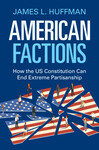
American Factions: How the U.S. Constitution Can End Extreme Partisanship
Files
Description
Americans of all political stripes are becoming increasingly frustrated with the partisanship of present-day politics. Democrats and Republicans alike claim mandates on narrow margins of victory and are quick to condemn their opponents as enemies of the public good. The Framers of the Constitution understood that such divisions are rooted in the political factions inherent in democracy. Their solutions were federalism, the separation of powers, bicameralism, judicial review and other structural constraints on majority rule. Over the course of US history some of those constraints have been eroded as American politics have become more democratic and less respectful of the liberties and freedoms the Framers sought to protect. American Factions advocates for a renewed understanding of the problem of political factions and a restoration of the Constitution's limits to revive a politics of compromise and bipartisanship.
- Surveys the framing history of the Constitution with a focus on the pervasive effort to control political factions
- Outlines where the Framers' constitutional design has been altered by amendment and judicial interpretation
- Provides solutions for the problem of political division, pointing to governmental structure, education, and appeals to civic virtue
ISBN
9781009768139
Publication Date
2026
Document Type
Book
Publisher
Cambridge University Press
City
New York
Keywords
political factions, Democrats, Republicans, Framers, politics, bipartisanship, compromise, separation of powers, originalism, majoritarianism, civic virtue
Disciplines
Law | Law and Politics | Law and Society | Legal History
Recommended Citation
James L. Huffman, American Factions: How the U.S. Constitution Can End Extreme Partisanship ( 2026).
https://lawcommons.lclark.edu/faculty_books/42